Saturday, February 28, 2026
https://www.dailymail.co.uk/travel/article-15587165/inside-eerie-abandoned-hotel-spain-millions-demolish.html
Inside the eerie abandoned hotel in Spain that will now take millions to demolish – and the scary story behind it
By JOWENA RILEY, TRAVEL WRITER
Published: 20:15 EST, 24 February 2026 | Updated: 20:15 EST, 24 February 2026
*** begin quote ***
A beachfront hotel in Spain that has been lying in ruin for over 50 years has been earmarked for demolition – a project that is expected to cost taxpayers €2.3 million (£2 million).
Hotel Añaza – known locally as the ‘Ghost Hotel’ – has stood as an urban eyesore for over five decades on the coast of Acorán, just south of Santa Cruz de Tenerife.
The 22-storey Y-shaped structure, first constructed in 1973, is one of the most notorious abandoned landmarks in the Canary Islands – not just for its haunting appearance, but for the dark history of five lives lost within its walls.
*** end quote ***
I have no idea of the total cost of the loss. Aside from the demolition and construction, all the costs should include the hopes and dreams of the local population. The investors take a hair cut; no sympathy there. But where are the insurers and performance bonds? Of course, the Gooferment politicians and bureaucrats pay no price. If anything they claim “successful” regualtion for getting rid of an eyesore and hazard.
Wonder how this will become DJT’s fault?
Argh!
— 30 —
 Leave a Comment » |
  ECONOMICS | Tagged: dailymail., Hotel Añaza, JOWENA RILEY, Spain |
  Permalink
 Posted by reinkefj
Friday, February 27, 2026
I’ve often heard people struggle with the old style secondary security authorization questions. You know: “What’s your favoite color”, or pets name, or school street.
I, long ago, decided that it was a “stupid control”. So, in my passwrd manager, I’d record the questions and give absurd answers. So, “what’s your favorite color”, became red158, pet’s name, red247, and street, red532.
Solved that problem.
I still object to 2FA that rely on an SMS message and prefer Google Authenticator.
But what do I know.
And, I don’t care for PASSKEYS either. Not good for sites where I may have multiple ids or different Users.
Argh!
I also don’t like using my email for a User id.
Argh!
— 30 —
Leave a Comment » | SECURITY | Tagged: Google authenticator, passkeys, security authorization questions, SMS message | Permalink
Posted by reinkefj
Thursday, February 26, 2026
https://51st.news/potomac-spill-dc-trump-emergency-disaster/
After the massive sewage spill into the Potomac, a shitload of questions remain
- Meanwhile, Trump has waded into the debate, and Bowser asked to declare it a presidential emergency disaster.
Martin Austermuhle
February 19 2026 12:43 PM
*** begin quote ***
It was a month ago that a massive pipe running from the Virginia suburbs to the Blue Plains Advanced Water Treatment Plant in D.C. ruptured, resulting in a massive discharge of raw sewage into the Potomac River.
The spill itself has been largely contained, but the political shitstorm has just started. Questions are flying about what D.C. Water knew about the condition of the aging sewage pipe, what the agency and local jurisdictions could have done to better notify the public, how long the repairs will take, and what the ultimate impact on the river might be.
*** end quote ***
As usual, the Gooferment is immoral, ineffective, and inefficient. As well as untrustworthy.
Aging infrastructure and conflicting jurisdictions makes for great political headlines but does nothing, less than nothing, to get to the root of the problem.
Bottom line: Privitization at least demonstrates that individual responsibility with profit motives can more correctly ensure that capital infrastructure gets maintained.
Hopefully, “We, The Sheeple” will recognize the villians in this drama.
One can complain about HOAs but for the most part they seem to — for the most part — can manage their infrastructure. Imagine it is the “solution” to Gooferment boondoggles?
— 30 —
Leave a Comment » | GOVEROTRAGEOUS | Tagged: 51st.news, aging sewage pipe, D.C. Water, DJT4547, Martin Austermuhle | Permalink
Posted by reinkefj
Wednesday, February 25, 2026
Report: The FBI Bent Its Own Rules To Spy on 1,100 ‘Sensitive’ Targets
Opening investigations requires evidence, so the feds created “assessments.”
J.D. Tuccille | 2.16.2026 7:00 AM
*** begin quote ***
The FBI has frequently been caught spying on Americans. It’s obvious the feds are dedicated to continued domestic snooping, even if that requires working around restrictions on their activities.
*** end quote ***
What else needs to be said?
— 30 —
Leave a Comment » | GOVEROTRAGEOUS | Tagged: assessments, J.D. Tuccille, REASON.COM | Permalink
Posted by reinkefj
Tuesday, February 24, 2026
https://www.malone.news/p/book-review-22-cells-in-nuremberg?publication_id=583200&post_id=188831026&isFreemail=true&r=3snn7d&triedRedirect=true
Book Review: 22 Cells In Nuremberg A Psychiatrist Examines the Nazi Criminals
Dr. Douglas M. Kelly’s psychological analysis that drives Sony Pictures’ Groundbreaking Docudrama
Dr. Robert W. Malone
Feb 23, 2026
*** begin quote ***
His four prescriptions for preventing an American totalitarianism are: universal and unrestricted voting rights; maximal voter participation; refusal to vote for politicians who exploit racial and religious divisions; and fundamental educational reform aimed at producing citizens capable of critical thought rather than emotional susceptibility. He acknowledges that these are simple to describe and extraordinarily difficult to achieve. His final note is not optimistic so much as it is unsentimental: the choice belongs to citizens, individually, and the alternative to making it wisely is visible in the rubble of Europe.
*** end quote ***
I am going to watch that Nuremberg Netflix movie and it may induce me to read the book.
Not that I have any way of influencing the future. Maybe this post will encourage others.
— 30 —
Leave a Comment » | INTERESTING | Tagged: Book Review, Douglas M. Kelly, Nazi Criminals, Robert W. Malone | Permalink
Posted by reinkefj
Monday, February 23, 2026
FROM TWITTER / X
.<>
VisionaryVoid
@VisionaryVoid
·
*** begin quote ***
In 1950, the United States government launched a secret biological attack on its own citizens—and for 20 years, they didn’t tell a soul.
It was a crisp September morning in San Francisco when a US Navy ship began spraying a massive, invisible cloud of bacteria into the fog just outside the Golden Gate Bridge.
This wasn’t a foreign enemy; it was the US military. Over the course of six days, they released Serratia marcescens and Bacillus globigii—two pathogens chosen specifically because they were thought to be “harmless.” The goal was to track how a biological weapon would spread through a major American city.
The experiment was a terrifying success. The bacteria swept through the city’s microclimates, infiltrating every neighborhood, school, and hospital.
By the end of the week, nearly all of San Francisco’s 800,000 residents had inhaled millions of bacterial spores. The military monitored the spread using 43 sampling stations, proving that a single release could effectively infect an entire metropolitan area.
But there was a problem with the “harmless” theory. Within days of the spraying, a local hospital saw an unprecedented outbreak of rare urinary tract infections.
Eleven people were hospitalized with serious complications. One man, Edward Nevin, a retired pipefitter recovering from surgery, died three weeks later after the bacteria reached his heart.
The military kept the data classified, and the public remained completely unaware that they had been used as lab rats in a simulated doomsday scenario.
It wasn’t until 1976, during a Senate subcommittee hearing, that the truth of “Operation Sea-Spray” finally emerged, forever shattering the illusion of domestic safety during the Cold War.
*** end quote ***
I never heard of this one BUT, (and there is always a BIG butt), I’m not surprised. Are you?
— 30 —
Leave a Comment » | CONSPIRACYTHEORY: | Tagged: US Navy, @VisionaryVoid, Edward Nevin | Permalink
Posted by reinkefj
Sunday, February 22, 2026
https://www.ecoticias.com/en/all-u-s-social-security-numbers-may-need-to-be-changed-following-a-massive-breach-that-is-already-being-investigated-as-a-national-threat/27158/?utm_source=tldrinfosec
By ECONEWS
Published On: February 13, 2026 at 6:30 PM
All US Social Security numbers may need to be changed following a massive breach that is already being investigated as a national threat (4 minute read)
*** begin quote ***
A whistleblower alleges a federal tech team improperly cloned the master Social Security database into a poorly governed cloud, potentially exposing rich identity data on 300+ million Americans and enabling long‑term fraud. Lawmakers have demanded criminal investigations. Officials insist that core systems remain secure.
*** end quote ***
Might be a blessing in disguise. Time to change from SSN as the universal identifier to NOTHING!
Anything that uses SSN should be eliminated.
We don’t need a Gooferment controlled registry. Maybe I’ve watched too many Nazis in movies demanding “Wo sind Ihre Papiere?” “Where is your papers?” There doesn’t seem to be a over whelming Gooferment “need” for such!
Maybe this is a perfect opportunity to end social security number, Social Security Insurance itself, and ALL the Gooferment welfare programs that hang off of it.
Time to cut the Gordian Knot!
— 30 —
Leave a Comment » | SECURITY | Tagged: ECONEWS, Social Security numbers | Permalink
Posted by reinkefj
Saturday, February 21, 2026
https://www.thefocalpoints.com/p/what-is-the-smallest-worthwhile-difference?publication_id=1119676&post_id=188707056&isFreemail=true&r=3snn7d&triedRedirect=true
What is the Smallest Worthwhile Difference in Cardiovascular Risk?
Novel measure tested for public acceptance of statin therapy
Peter A. McCullough, MD, MPH
Feb 21, 2026
*** begin quote ***
The investigators applied an explicit decision-making metric—the Smallest Worthwhile Difference (SWD)—defined as the minimum absolute risk reduction in ASCVD events that individuals consider sufficient to justify long-term statin use.
*** end quote ***
I’m on a statin and have been for awhile. Both my GP and cardio doc recommended it, back before the COVID craziness and I, along with a lot of people, lost confidence in Big Pharma and Big Medicine. Of course, no one should ever have any trust in Gooferment politicians and bureaucrats. During the interim after I started static, I’ve seen a lot of chatter about statins, side effects, and risks. Makes me less confident in the therapy.
BUT, (and there is always a BIG butt), I’ve gotten this far with their advice so I’ll stick with it. Concerned but befuddled.
YMMV (Your Mileage May Vary!)
As Sharyl says: “Do Your Own Research. Make Up Your Own Mind. Think For Yourself.” — Sharyl Attkisson
If you’re wrong, at least you make your own decision with “informed consent”.
I trust my car to an “expert”; in the absence of evidence to the contrary, I guess I’ll trust my doctors. For Now!
— 30 —
Leave a Comment » | Healthcare | Tagged: Peter A. McCullough, Sharyl Attkisson, statin, thefocalpoints | Permalink
Posted by reinkefj
Saturday, February 21, 2026
https://www.mentalfloss.com/language/hidden-bias-left-handedness-bad-thing
The Hidden Bias in Language That Turned Left-Handedness Into a Bad Thing: While the days of forcing left-handed children to use their right hands are mostly over, the bias against lefties continues in most languages around the world. The word “sinister” literally means “left.” From Latin roots to modern idioms, language has been quietly slandering lefties for centuries. (Mental Floss)
# – # – # – # – #
I was lefty before Katholick Skrule beat me out of it.
Wonder how that impacted me?
Too long ago to know much and all the folks in my family have long passed.
Time to invoke my “one year rule” — Less than a year ago, admit mistakes may have been made; more than a year ago, it’s history, immutable, forget about it.
— 30 —
Leave a Comment » | HEALTH | Tagged: mentalfloss.com, mistakes | Permalink
Posted by reinkefj
Friday, February 20, 2026
https://www.malone.news/p/friday-funnies-promises-promises?publication_id=583200&post_id=187789750&isFreemail=true&r=3snn7d&triedRedirect=true
Friday Funnies: Promises, Promises…
And other true stories
Dr. Robert W. Malone
Feb 13, 2026
# – # – # – # – #

# – # – # – # – #
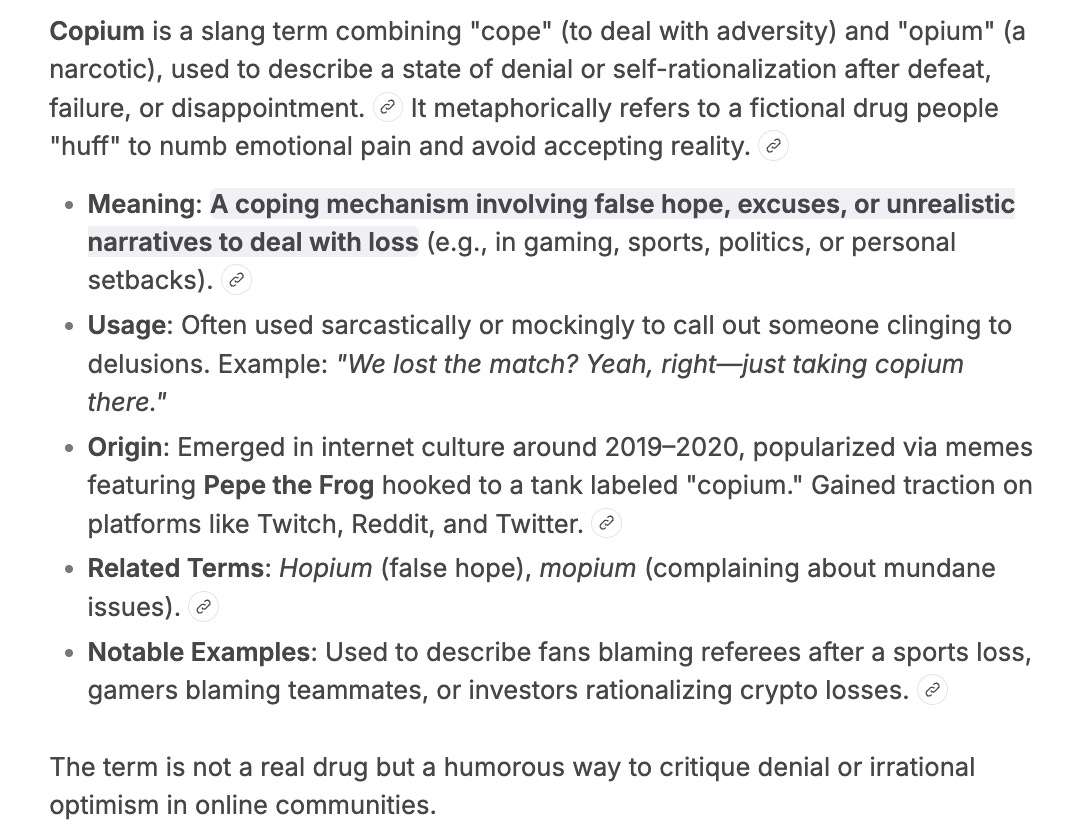
Copium, Hopium, Mopium, and Pepe the Frog … …
… … gives me three new words to add to my vocabulary.
- Copium ==> to deal with a state of denial
- Hopium ==> to have false hope
- Mopium ==> to complain about mundane issues
Useage:
- I use copium to handle all the Epstein fodder.
- I take hopium that all the villains in the Epstein matter get justice.
- I use mopium to complain about all the politicians and bureaucrats obfuscating about Epstein.
Three good new words.
Credit where credit is due.
— 30 —
Leave a Comment » | VOCABULARY | Tagged: Copium, Dr. Robert W. Malone, Friday Funnies, Hopium, Mopium | Permalink
Posted by reinkefj
Thursday, February 19, 2026
https://internationalman.com/articles/the-empire-killer-strikes-again/
The ‘Empire Killer’ Strikes Again
by Nick Giambruno
2026-02Feb-11
*** begin quote ***
The US federal government has the biggest debt in the history of the world. And it’s continuing to grow at a rapid, unstoppable pace.
While the US government can extend the charade of solvency longer than any other entity on the planet, not even the most powerful empires in human history can do so forever, particularly when they start to struggle to pay the interest costs.
The situation has reached a tipping point.
That’s because the federal debt’s annualized interest cost exceeded the defense budget for the first time last year.
It’s on track to exceed Social Security and become the BIGGEST item in the federal budget.
*** end quote ***
It’s the debt, deficits, waste, fraud, corruption, and the deep state.
Everything else — Big Pharma, Military Industrial Congressional Complex, Illegal Immigration, and Socialism rot — are all “minor” in comparison.
“We, The Sheeple” MUST wake up and demand the politicians and bureaucrats address the national debt NOW. Let’s have some old fashioned “innovation” — no Federal welfare period, full stop. No Federal intrusion into States. Let’s have some long term Gooferment bonds in gold to refinance the 39T$ in Gooferment debt. With a plan to pay it off over the next 100 years.
Argh!
— 30 —
Leave a Comment » | DISCOURAGING | Tagged: Big Pharma, internationalman, Military Industrial Congressional Complex, Nick Giambruno | Permalink
Posted by reinkefj
Wednesday, February 18, 2026
https://www.ericpetersautos.com/2026/02/05/what-if-epstein-is-about-something-worse/
What if Epstein is About Something Worse?
By
Eric Peters –
February 5, 2026
*** begin quote ***
As has been observed, if voting constituted a meaningful threat to politicians it would not be allowed. Stalin allowed people to vote. It was meaningless then. It is meaningless now – because your vote to be left alone is meaningless. It will only have meaning when your right to be left alone cannot be voted away. And that will only happen when people – most people, at least – decide they do not want to be gangsters themselves. This will take some soul searching. They will have to come face-to-face with the ugliness many – most of them – wish to pretend they’re not part of. The ugliness of violence. Of taking what is not theirs – by voting to have someone else threaten other people with violence to get what isn’t theirs.
*** end quote ***
“If voting made any difference they wouldn’t let us do it.” — Emma Goldman ― often incorrectly attributed to American humorist Mark Twain ― but very very true imho!
Walter Block’s Libertarian Voting Rule is that in close races you vote for the major party candidate that is less evil. In races that aren’t close, you cast a protest vote for the Libertarian Party candidate. https://buff.ly/2GFxxPl
I’m beginning to think that all those who refuse to vote have the correct strategy.
Not that, by ignoring it, the gang that calls itself Gooferment will just go away.
BUT, (and there is always a BIG butt), they can never ever claim a “mandate” since half the population just stays home.
I think that the Walter Block strategy, that I’ve been following, isn’t getting me a better life. If anything, it’s getting worse.
Short of another Civil War, I don’t see how we are going to get back to the Dead Old White Guys’ vision of liberty. Sound money, no taxes, and rugged individualism.
No robbing Peter to bribe Paul to vote.
Argh!
— 30 —
Leave a Comment » | Political | Tagged: Eric Peters, ericpetersautos.com | Permalink
Posted by reinkefj
Tuesday, February 17, 2026
On The Border is closing the new brunswick location on Sunday 2026-02Feb-22. According to the bartender, they can’t afford the rent. The employees got a weeks notice and no severance. They may be able to transfer to another OTB location like Princeton. I guess the developers want something more “up scale”? Demonstrates that there is no such thing as “loyalty” to Anyone — employees, Customers, suppliers. Argh!
— 30 —
Leave a Comment » | NEW JERSEY | Tagged: NEWJERSEY | Permalink
Posted by reinkefj
Tuesday, February 17, 2026
https://www.vigilantfox.com/p/the-most-unsettling-reality-about?publication_id=975571&post_id=187200412&isFreemail=true&r=60qmwq&triedRedirect=true
Real Health
The Most Unsettling Reality About Modern Medicine
Money is often the root of all evil, and the medical system is no exception. But there’s something even more disturbing going on that nobody is talking about.
The Vigilant Fox
Feb 09, 2026
*** begin quote ***
There’s a reason doctors love pushing vaccines. The more they inject, the more money they make.
The foot traffic alone brings in big money, but there’s another perverse incentive, and once you hear it, it will make you angry.
RFK Jr. explains: “Pediatricians who vaccinate 80-85% of the kids in their office, get these giant bonuses… And that’s why they throw you out of the office if you fight back…You’ll lose them their bonuses.”
Sadly, these perverse financial incentives aren’t limited to vaccines but across many areas of medicine.
*** and ***
It revealed how, during COVID, core medical ethics quietly collapsed—how consent became optional, coercion was reframed as care, and vulnerable people were treated as obstacles rather than patients.
This isn’t about ideology. It’s about what happens when fear, authority, and institutional pressure override conscience.
*** end quote ***
Disgusting. Any wonder why no one respects ”experts”?
“If you’re not paying for it, then you are the product.” — Unknown, but old internet adage
In this case, “We, The Sheeple” are nothing more that cash cows to be milked, abused, and killed when “necessary”. Informed Consent — that’s a joke. Medical ethics are another joke.
This is a “War Crime” and the perps should be hung!
— 30 —
Leave a Comment » | Healthcare | Tagged: RFK Jr., The Vigilant Fox, vaccines, vigilantfox.com | Permalink
Posted by reinkefj
Monday, February 16, 2026
2026-02Feb-16
Year of the Fire Horse
Lunar New Year celebrations kick off tomorrow, ushering in the Year of the Fire Horse in the Chinese zodiac. The 15-day festivities, observed by billions worldwide, start with the new moon and end with the Lantern Festival. China anticipates a record 9.5 billion trips during the 40-day travel rush around the holiday, the world’s largest annual human migration.
The horse is the seventh animal in the 12-year zodiac cycle and symbolizes energy, independence, and ambition. Those born in horse years are seen as dynamic, courageous, and charismatic. Many see the Year of the Fire Horse as a time to take bold steps, embrace change, and pursue new opportunities. The last Fire Horse year occurred in 1966; notable births include Adam Sandler, Gordon Ramsay, Halle Berry, and Helena Bonham Carter. See your zodiac animal here.
Traditions focus on family and fortune (see our overview), including gifting lai see or hóngbāo to children—red envelopes filled with “lucky money.” See a guide to the holiday, closely associated with the Spring Festival and Chinese New Year, here.
# – # – # – # – #
We can all use some “lucky money”!
— 30 —
Leave a Comment » | FUN | Tagged: ambition, energy, independence | Permalink
Posted by reinkefj
Monday, February 16, 2026
https://www.stripes.com/branches/marine_corps/2026-02-09/okinawa-guam-marines-relocation-20676544.html
Think tank calls for keeping Guam-bound Marines on Okinawa to counter China
By Brian McElhiney Stars and Stripes • February 9, 2026
*** begin quote ***
The report, released Feb. 3 by the Atlantic Council, recommends keeping about 5,000 Marines on Okinawa rather than relocating them to Guam and retaining the Corps’ airfield in densely populated central Okinawa along with a replacement runaway under construction farther north.
*** end quote ***
Sorry, but they should come home to the USA.
“A veteran is someone who at one point in his life wrote a blank check made payable to the ‘United States of America’ for an amount of ‘up to and including my life.'” -Anonymous
Time for the “American Empire” to shrink back to its Constitutional size.
“Older men start wars, but younger men fight them.” ~ Albert Einstein
Let’s bring all the girls, boys, women, and men home now! We have so many politicians and bureaucrats to send in their place if it’s really needed!
— 30 —
Leave a Comment » | VETERANS | Tagged: Brian McElhiney, Marine Corps, Stars and Stripes, stripes | Permalink
Posted by reinkefj
Sunday, February 15, 2026
https://nypost.com/2026/02/07/us-news/five-robbers-three-wanted-by-ice-held-up-couple-in-nyc/
Armed migrant robbery crew busted after NYC hold-up— immediately released without bail
By Tina Moore
Published Feb. 7, 2026, 2:55 p.m. ET
*** begin quote ***
Wilson Eduardo, 18; Emerson Valenzuela, 20; Christopher Serrano, 18, and Edwin Ramos, 18, were arrested and charged with robbery, criminal possession of a weapon, criminal possession of stolen property and menacing, police said.
They all pleaded not guilty and were released on non-monetary conditions, online court records show.
*** end quote ***
Any wonder why crime is rampant in the USA?
Sorry, but criminals get back out on the street before the cops get the paperwork done.
“Victim disarmament is the view that it is somehow better to see a woman raped in an alley and strangled with her own pantyhose, than see her with a gun in her hand.” — T.D. Melrose
The cash cows of the Pepuls Republik of Nu Jerk can’t even defend themselves.
But politicians and bureaucrats get armed security?
Argh!
And, three of the CRIMINALS has ICE “detainers” on them. Lot of good that does.
Sorry, but the gang called Gooferment is failing in its “raison d’être”, reason for existence.
Time to start impeaching judges!
— 30 —
Leave a Comment » | DISCOURAGING | Tagged: non-monetary conditions, nypost, Tina Moore | Permalink
Posted by reinkefj
Saturday, February 14, 2026
Barfed during boot up and now I have circle ?
About all I can do is take it in for support.
Argh!
Warning — don’t upgrade.
— 30 —
Leave a Comment » | APPLE | Tagged: 23.3 | Permalink
Posted by reinkefj
Saturday, February 14, 2026
https://internationalman.com/articles/venezuelas-oil-fantasy-meets-physical-reality/
Venezuela’s Oil Fantasy Meets Physical Reality
by Chris MacIntosh
My friend Tracy Schuchart makes the point well:
“Canada exports 4.3M bpd to the US. Venezuela’s entire production is 23% of what Canada already ships.
The rebuild timeline is a decade minimum, likely longer. Rice University’s Monaldi says at least 10 years and $100+ billion in investment to get back to 4 million bpd. PDVSA itself says $58 billion just for pipelines that haven’t been updated in 50 years. That’s before you drill a single new well.
Here’s the part markets are missing: Trump doesn’t control the oil. The VP who hates the US is in charge. No stable pro-Western government means no foreign investment. Nobody’s pouring $100 billion into a country run by someone hostile to them. The whole supply increase story requires political stability that doesn’t exist.
Canadian infrastructure is already built and connected. Alberta to US Gulf Coast and Midwest refineries through established pipelines. Those refineries are configured for Canadian heavy crude after decades of optimization.
Even if Venezuela eventually gets production up in the 2030s, it’s the same heavy sour crude Canada produces. More heavy crude globally just validates continued investment in heavy crude refining infrastructure, which benefits Canada.”
# – # – # – # – #
So all this posturing about “Venezuela’s Oil” is decades away from benefitting JoeSixPacK. So why are we even involved.
DJT47 is distracted from the real problems of the USA — debt, deficits, fraud, and the deep state.
I remember when James Carville and Bill Clinton papered the White House offices with: “It’s the ECONOMY, stupid”. And low and behold, with a Republican controlled House and Senate, the economy improved.
Maybe there’s a lesson for DJT47, politicians, and bureaucrats!
“ … … debt, deficits, fraud, and the deep state … … “
— 30 —
Leave a Comment » | Ranting | Tagged: Chris MacIntosh, DEBT, deficits, DJT47, FRAUD, James Carville, the deep state, Tracy Schuchart | Permalink
Posted by reinkefj
Friday, February 13, 2026
COSTCO CITIBANK
couldn’t logon;
couldn’t retrieve id;
couldn’t register;
1-855-378-6467 unhelpful;
Told I had a secret word; dammed if I knew it.
Told no such account — reregister.
Couldn’t reregister.
Used mobile app. No problem. Wasted almost an hour. Guess I do have an account there.
What a <synonym for the act of procreation in real time> mess.
Was going to document and submit to both “Customer Care” but figured why waste more of my limited time on this earth getting frustrated.
‘If a battle can’t be won, don’t fight it,’ cautioned Sun Tzu, the revered Chinese warrior from 544-496 BC ”The Art of War’
— 30 —
Leave a Comment » | Ranting | Tagged: 1-855-378-6467, CITIBANK, COSTCO, Sun Tzu | Permalink
Posted by reinkefj
Friday, February 13, 2026
*** begin quote ***
Re: (2) Kevin – WE THE PEOPLE🦁 on X: “🚨🚨🚨 Former FBI director, Ted Gunderson👇 : “Look what’s happened in the last 20 years…. Oklahoma City bombing = Huge cover up Jack Kennedy assassination = Huge cover up Bobby Kennedy assassination = Huge cover up World Trade Center = HUGEEE cover up
*** end quote ***
FROM LUDDITE:
*** begin quote ***
I’m sorry but a vast majority of Americans do not believe in any of those hoaxes. You are way out on the fringe my friend, but I luv ya anyway!
Sent from my iPad
*** end quote ***
Respectfully agree to disagree. These conspiracy theories have legs because the government hides and lies.
“You’re entitled to your own opinion but you’re not entitled to your own facts.” —Daniel Patrick Moynihan
“It is merely the etherealization of common sense. …when you can measure what you are speaking about, and express it in numbers, you know something about it;…” William Thomson (June 26, 1824–December 17, 1907), 1st Baron Kelvin, often referred to simply as Lord Kelvin, was an Irish mathematical physicist.
ConspiracyTheories: I have a “thermometer” for measuring these
Checking the Conspiracy Theorist “thermometer” (i.e., Conspiracy Theory Taxonomy and Ruler Type and Veracity) says: it is
- Governmental
- Political
- Historical
- Commercial
- Miscellaneous
- Health
- Generally Accepted As True
- More likely than not
- More likely than not
- Plausible
- Possible
- Less likely than not
- Unlikely
- Generally Accepted As False
Note to Self: I have to add “Proven True”!
- JFK is moving up from “more likely” to “likely”.
- RFK is still “Possible”
- OKC is still “More likely than not”
- AND THE BIG ONE911 is “LIKELY” based on WTC7 records and PENTEGON audits were destroyed.
And, on and on and on.
In other NEWS, the GROUNDHOGS DAY, Tooth Fairy, and Easter Bunny remain at “Generally Accepted As False” with JUMBOSHRIMP, HEALTHYCHOICE, and HONESTPOLITICIAN.
While SANTACLAUS remains at “Possible”.
Seriously, the litany of Gooferment Coverups is growning: Wacco, Ruby Ridge, Elian Gonsales, … … WUHAN, PLANDEMIC, “Vaccines”, CLOTSHOT, “politicians and bureaucrats getting saline”, BigPharma bribing docs … … I’ll have to start keeping that list for you!
“There are none so blind as those who will not see” resembles Matthew 13:13, which is about people who have eyes but do not perceive the truth.
Sigh!
— 30 —
Leave a Comment » | CONSPIRACYTHEORY: | Tagged: 911, JFK assasination, Luddite, TFHOKC, TFHRFK | Permalink
Posted by reinkefj
Thursday, February 12, 2026
https://nypost.com/2026/02/05/us-news/ny-archdiocese-accuses-chubb-insurer-of-double-dealing-on-sex-abuse-cases/
NY Archdiocese accuses insurance company of double dealing on sex abuse cases, posing as victims’ rights group
By Carl Campanile
Published Feb. 5, 2026, 6:55 a.m. ET
*** begin quote ***
“Knowing the insureds face more than 1,500 Underlying claims involving allegations of the gravest magnitude, Chubb reassured them to their face while secretly stabbing them in the back for years,” church lawyers said in the filing. “Such fraud and sabotage easily meet the threshold for moral culpability necessary for punitive damages.”
*** end quote ***
If you lie down with dogs, you get up with fleas, or in Latin, qui cum canibus concumbunt cum pulicibus surgent. “He that lieth down with dogs shall rise up with fleas” has been attributed to Benjamin Franklin ‘s Poor Richard’s Almanack
It saddens me that this moral disaster keeps coming back up again and again.
An “insurance company” subverting the interests of its insured to avoid paying off? I’m shocked. Shocked I say.
“I’m shocked, shocked to find that gambling is going on in here!” Captain Renault in Casablanca
It’s a total disgrace that the Catholic Church has not purged itself of everyone connected to this scandal.
And, to make it about money, just seems to amplify it and make it worse.
Argh!
— 30 —
Leave a Comment » | DISCOURAGING | Tagged: Carl Campanile, Chubb, NY Archdiocese, nypost | Permalink
Posted by reinkefj
Wednesday, February 11, 2026
https://nypost.com/2026/02/03/business/disney-reveals-enormous-38m-pay-package-for-new-ceo-josh-damaro/?lctg=6080ba40747925275a09dcd3
Disney reveals enormous $38M pay package for new CEO Josh D’Amaro
By Ariel Zilber
Published Feb. 3, 2026, 10:32 a.m. ET
*** begin quote ***
D’Amaro, the head of Disney theme parks, will earn an annual base salary of $2.5 million as well as a one-time bonus of $9.75 million once he takes over the helm, according to SEC filings.
Each year that D’Amaro serves as CEO, he will receive a long-term stock incentive of $26.2 million as well as an annual bonus of 250% of his base salary on the condition that he meets certain performance goals.
*** end quote ***
Sorry, but I don’t believe that ANY C level of anything should be paid more than the President.
It’s “unseemly” and well as an insult to any wage slave.
AT BEST, the CEO should receive any “excessive compensation” (i.e., more than the President of the USA) in the form on non-transferable corporate bonds or corporate shares laddered over say 50 years. Gone are the days when we should allow the “managerial class” to rob the corporation and shareholders of their wealth by pursuing short-range plans to jack up the stock price and leave with tremendous windfalls while the corporation spirals into bankruptcy! Leaving the stockholders and stakeholders (i.e., employees; suppliers; related businesses) holding the “bag” of the corporation’s losses. Thinking specifically of GM that got a Gooferment bailout and everyone else involved get screwed.
So, since “corporations” are a creation of the Gooferment, and sometimes treated like real people, it seems reasonable that there should be some ground rules about what they can and can not do. In addition to compensation restrictions, I don’t think that they should be able to contribute money to anything but dividend to their shareholders.
I’m tired of playing in a rigged game.
— 30 —
Leave a Comment » | Political | Tagged: Ariel Zilber, nypost | Permalink
Posted by reinkefj
Tuesday, February 10, 2026
https://www.scientificamerican.com/article/mystery-prototaxites-tower-fossils-may-represent-a-newly-discovered-kind-of/?_bhlid=b28c50ad6772e1dca2572e0b334b3909d5119e8a
January 21, 2026
Mystery tower fossils may come from a newly discovered kind of life
- Towering Prototaxites ruled Earth before trees—and they may have been a form of life entirely new to science
By Cody Cottier edited by Sarah Lewin Frasier
*** begin quote ***
Now, after comparing fossils from these cryptic organisms with fossil fungi from the same rock deposit, the authors of the new study, published today in Science Advances, conclude that Prototaxites was likely a distinct lineage. That would place it on an equal footing with the six currently recognized kingdoms of life: those of plants, animals, fungi, protists, bacteria and archaea.
*** end quote ***
I was familiar with plants and animals. Didn’t realize that fungi was another branch. And, frankly, never heard of protists (a diverse group of mostly unicellular, eukaryotic organisms that do not fit into the animal, plant, or fungi kingdoms). Also, never got the memo that bacteria and archaea were promoted; kind like the reverse of Pluto being demoted?
Referring to the Johari window http://en.wikipedia.org/wiki/Johari_window, there seems no end to my personal Pane Two (what I can’t see) and an equally large Pane Four (what we both can’t see).
Hopefully something in Pane Four won’t wipe out the human race?
— 30 —
Leave a Comment » | INTERESTING | Tagged: Animals, archaea, bacteria, Cody Cottier, fungi, kingdoms of life, plants, protists, Sarah Lewin Frasier, scientificamerican | Permalink
Posted by reinkefj
Monday, February 9, 2026
https://nypost.com/2026/01/29/opinion/how-china-supercharged-birth-tourism-and-scammed-american-citizenship-for-up-to-1-5-million-babies/
How China supercharged ‘birth tourism’ and scammed American citizenship for up to 1.5 million babies
By Peter Schweizer
Published Jan. 29, 2026, 6:30 a.m. ET
*** begin quote ***
“Birth tourism” — where pregnant women have their child on America soil to become citizens — has been happening for decades. But Chinese elites have “weaponized” the practice, says author Peter Schweizer, raising a generation of legal citizens who have no loyalty to the US. In this excerpt from his new book, “The Invisible Coup: How American Elites and Foreign Powers Use Immigration as a Weapon,” he explains how.
*** and ***
Since the US government does not directly track birth tourism, we must rely on estimates. In 2012, one nonprofit calculated that about 36,000 foreign-born women gave birth in the United States and then left the country.
*** end quote ***
Without a doubt, DJT47 needs to eliminate these loopholes.
We need to “correct” this for tourists AND illegal immigrants!
It seems OBVIOUS to me!
— 30 —
Leave a Comment » | Policy | Tagged: American citizenship, birth tourism, DJT47, nypost, Peter Schweizer, The Invisible Coup | Permalink
Posted by reinkefj
Sunday, February 8, 2026
https://nypost.com/2026/02/01/us-news/jfk-assassination-film-held-by-feds-could-be-worth-900m-and-could-prove-2nd-shooter-on-grassy-knoll/?lctg=6080ba40747925275a09dcd3
JFK assassination film held by feds could be worth $900M – and could prove 2nd shooter on ‘grassy knoll’
By Geoff Earle
Published Feb. 1, 2026, 3:38 p.m. ET
*** begin quote ***
A 62-year-old home movie could blow the JFK assassination wide open — and prove once and for all there was a second shooter on the grassy knoll that fateful day.
The grainy 8mm footage, captured by Dallas air conditioner repairman Orville Nix as bullets ripped through Dealey Plaza on Nov. 22, 1963, hasn’t been seen since 1978, when it was sent away for analysis by an LA company and later fell under federal ownership – although the feds claim they don’t have it.
Nix died in 1972, and his granddaughter picked up from her late dad the legal war to recover his film — which she’s convinced is worth more than $900 million as it may hold the key to exposing one of history’s biggest coverups.
Now a federal judge has ruled that the battle over the film can go forward — and the footage might finally see the light of day.
*** end quote ***
“My first rule: I don’t believe anything the government tells me.” — George Carlin
https://reinkefaceslife.com/2009/01/01/conspiracytheories-i-have-a-thermometer-for-measuring-these/
Checking the Conspiracy Theorist “thermometer” (i.e., Conspiracy Theory Taxonomy and Ruler Type and Veracity) says: it is
- Governmental
- Political
- Historical
And I’d assess it as:
I hope that “the truth” eventually sets us free.
“Son, we live in a world that has walls, and those walls have to be guarded by men with guns. Whose gonna do it? You? You, Lt. Weinburg? I have a greater responsibility than you could possibly fathom. You weep for Santiago, and you curse the Marines. You have that luxury. You have the luxury of not knowing what I know. That Santiago’s death, while tragic, probably saved lives. And my existence, while grotesque and incomprehensible to you, saves lives. You don’t want the truth because deep down in places you don’t talk about at parties, you want me on that wall, you need me on that wall. We use words like honor, code, loyalty. We use these words as the backbone of a life spent defending something. You use them as a punchline. I have neither the time nor the inclination to explain myself to a man who rises and sleeps under the blanket of the very freedom that I provide, and then questions the manner in which I provide it. I would rather you just said thank you, and went on your way, Otherwise, I suggest you pick up a weapon, and stand a post. Either way, I don’t give a damn what you think you are entitled to.” Colonel Jessep in A Few Good Men played by Jack Nicholson
And, “I don’t give a damn what you think”.
Batten down the tin foil hats.
To quote Courtney B. Vance as Seaman Jones in “Red October” at 02:09:26 — “This one’s going to be close.”
Like a depth charge that detonates to close to the “Establishment Narrative”.
Who gets smeared as the biggest villain since Brutus stabbed Caesar?
— 30 —
Leave a Comment » | CONSPIRACYTHEORY: | Tagged: assassinations, Conspiracy Theories, Dallas, Dealey Plaza, Geoff Earle, JFK assassination, john f. Kennedy, nypost, Orville Nix, shootings | Permalink
Posted by reinkefj










 Reinke Faces Life
You must be logged in to post a comment.