INSPIRATIONAL: Costco cashier Tony Barzar is a millionaire by slow and steady hard work

Tuesday, July 14, 2026

https://www.wsj.com/business/retail/he-earns-33-an-hour-as-a-costco-cashier-now-hes-a-millionaire-1e9ba725?st=6YknCt&mod=1440&user_id=66c4b9c55d78644b3a882a4d

He Earns $33 an Hour as a Costco Cashier. Now He’s a Millionaire.

  • Long-tenured workers like cashier Tony Barzar are reliable, experienced and able to speed shoppers through a checkout line. Costco is willing to pay to keep them around.

By Sarah Nassauer
July 8, 2026 7:00 pm ET

*** begin quote ***

TUCSON, Ariz.—Costco cashier Tony Barzar unloaded his lunch in the breakroom, clocked in and headed for the checkout, just as he has for much of the past four decades.

That day, like most days, 60-year-old Barzar was assigned to the self-checkout area, a cluster of six registers. At 9:02 a.m., the first shoppers were ready to ring themselves up.

*** end quote ***

Not glamorous, not “big bucks”, but slow and steady wins the race.

A certainly no reason for ¾ of a million in student loan debt.

Maybe the zoomers need to adjust their expectations?

— 30 —


INSPIRATIONAL: My wife had to endure the old process … … 

Monday, June 29, 2026

https://openbionics.com/3d-printed-prosthetic-limbs-progress-in-prosthetics-challenges-in-access/

*** begin quote ***

At our Austin prosthetic clinic, upper limb specialist Travis Heins has seen firsthand how 3D printing can elevate the experience of receiving a prosthetic arm from a drawn-out series of appointments into a streamlined, more predictable process. Instead of multiple rounds of casting, adjustments and travel to and from the clinic, Travis uses digital models and printed test sockets to refine his patient’s fit in a fraction of the time. For families who often drive hours to reach a preferred clinic or rearrange work schedules for each appointment, these efficiencies matter.

“I print two test sockets from the same digital model, one based on conservative measurements and another designed for a more experimental fit,” he said. “Sometimes we end up going with the more aggressive modified one.”

*** end quote ***

My wife had to endure the old process … … 

… … (I’d say God’s replacement wife because the Universe knows how much I need help. And, it sounds disrespectful to say “second wife” and hurtful to refer to my sainted “first” wife as anything but the best thing that ever happened to me in my college days.  But enough distraction.) … … 

… … and the insurance company paid 60k$ and we had innumerable appointments for fittings.  And the end result sucked.  It was hard to get on and almost impossible for the two of us to get it off.  

AND most disturbing to her was that is looked like a man’s arm.

FMPOV the lack of an “elbow” was a terrible disaster.  

Maybe the new stuff will be better.

BUT, (and there is always a BIG butt), not in our lifetime.

— 30 —


INSPIRATIONAL: One can judge from experiment or one can blindly accept authority

Thursday, June 25, 2026

<<FROM FACEBOOK>>
<< EDITOR ADDED DATE 2026-06-09>>

Via @S Kent Troy

*** begin quote ***

“There are but two ways of forming an opinion in science. One is the scientific method; the other, the scholastic. One can judge from experiment or one can blindly accept authority. To the scientific mind, experimental proof is all important and theory is merely a convenience in description, to be junked when it no longer fits. To the academic mind, authority is everything and facts are junked when they do not fit theory laid down by authority.” — Robert A. Heinlein – Life-Line

*** end quote ***

It seems that we have had a belly full of “science by authority”.   The politicians and bureaucrats have no one else to blame but themselves for “vaccine skepticism”.  New item after news item keep “leaking out”, mostly via the inet, that destroy any credibility or “moral authority” they had.  

Personally, when the undertakers reported big stringy clots and health young athletic men started dropping like flies, I was “convinced” that the truth was being hidden like Hunter Biden’s laptop.   And, Fauci’s 6 foot rule and face masks for viruses just “confirmed” it for me.  It was all <synonym for excrement from a male cow> to cover a giant cash grab for cronies and a payday for Big Pharma, Hospitals, and insider trading politicians and bureaucrats!   Argh!

“My first rule: I don’t believe anything the government tells me.” — George Carlin

“It’s a big club, and you ain’t in it! You, and I, are not in the big club.” — George Carlin
https://www.youtube.com/watch?v=i5dBZDSSky0

“The word ‘bipartisan’ usually means some larger-than-usual deception is being carried out.” — George Carlin

A plague on all their houses.  They have set back human civilization and progress a thousand years or maybe 3 generations for it to be forgotten.

Argh!

— 30 —


INSPIRATIONAL: Match quality matters more than head start.

Monday, June 22, 2026

<<FROM TWITTER>>
<< EDITOR ADDED DATE 2026-05-09>>

https://x.com/ihtesham2005/status/2053103815482859767?s=20

Ihtesham Ali
@ihtesham2005

*** begin quote ***

A Hungarian psychologist raised three daughters to prove that any child could become a chess grandmaster through early specialization. He succeeded. Two of them became grandmasters. One became the greatest female chess player who ever lived.

Then a sports scientist looked at the data and found something nobody wanted to hear.

His name is David Epstein. The book is called “Range.”

The Polgar experiment is one of the most famous case studies in the history of deliberate practice. Laszlo Polgar wrote a book before his daughters were even born arguing that geniuses are made, not born. He homeschooled all three girls in chess from age four. By their teens, Susan, Sofia, and Judit were dominating tournaments against grown men. Judit became the youngest grandmaster in history at the time, breaking Bobby Fischer’s record. The story became the gospel of early specialization. Pick a domain young, drill it hard, and you can manufacture excellence.

*** and ***

There are two kinds of environments in which humans develop expertise. Psychologists call them kind and wicked. A kind environment has clear rules, immediate feedback, and patterns that repeat reliably.

*** and ***

A wicked environment is the opposite. Feedback is delayed or misleading. Rules shift. The patterns that worked yesterday may be exactly the wrong patterns to apply tomorrow. Most of the real world looks like this. Medicine is wicked. Investing is wicked. Building a company is wicked. Scientific research is wicked. Almost every job that involves a complex changing system with humans in it is wicked.

*** and ***

The skill that mattered in wicked environments was not depth in one pattern. It was the ability to recognize when a pattern from one domain applied unexpectedly in another.

*** and ***

Generalists do better in wicked domains for a reason that sounds almost mystical until you understand the mechanism. They have less invested in any single mental model, so they abandon broken models faster.

*** and ***

The single most useful sentence in the entire book is the one Epstein puts almost as a throwaway.

Match quality matters more than head start.

*** end quote ***

Fascinating insight.

So encourage children to try anything and everything.  When they find “their bliss”, then the magic will happen.

Have we been doing so many things wrong for so long?

— 30 —


INSPIRATIONAL: Dale Schroeder puts Big Charity to shame

Saturday, June 20, 2026

<<FROM TWITTER>>
<< EDITOR ADDED DATE 2026-06-06>>

https://x.com/CrazyVibes_1/status/2063349933110104394?s=20

*** begin quote ***

Image

“Blue collar Iowa carpenter used his secret fortune to send 33 strangers to college”. Upworthy

*** end quote ***

Appears to be real.  And if it is, he puts all the Big Charity to shame.

Gant, Michelle (July 25, 2019). “Blue collar Iowa carpenter used his secret fortune to send 33 strangers to college”. Upworthy. Retrieved March 28, 2026.

Dona Nobis Pacem

— 30 —


INSPIRATIONAL: Never destroy what you can not create

Tuesday, June 16, 2026

https://nautil.us/the-cold-wars-accidental-whale-observatory-1281682?_bhlid=1aaad0977e3eed40b090ec5815edb50bdc7f742b

The Cold War’s Accidental Whale Observatory

  • Built to track enemy submarines, the Navy’s underwater listening network inadvertently revealed that whales may be singing across entire oceans

By David Rothenberg
9:39 AM CDT on June 4, 2026

*** begin quote ***

Yet the thousand-mile song takes hold of our imagination right away: “I could show you the evidence today. I can listen in Puerto Rico to a whale way up on the Grand Banks. Can the whales do that? You might well ask, ‘What would they have to say?’ Then you’re suddenly putting on this silly human restriction. A whale might turn around and say to me, ‘What would you possibly have to say to one another sitting just two meters apart?’”

Like so many great scientists, Clark is not afraid to be a bit of a dreamer. More than once, he has sought out the advice of musicologists: “Marty Hatch, a specialist in Indonesian gamelan here at Cornell, had this to say to me, ‘You know Chris, you look at all this singing as data, but I think of it as a musical, emotional experience.’ Musicians hear song, and this is where I sometimes lean away from the scientific and tend to agree with them. Why can’t we just appreciate it as a phenomenon that is phenomenal?”

No human musician could stay in time counting as slowly as these whales do. These incredibly low thumps and moans are rhythms at such a lax pace that they are barely perceptible to human beings. Speed a blue whale song up 10 times, and 30 minutes becomes three. Move the pitch up to the realm of a cello, bowhead song, or a human moan, and exactly every three seconds comes the same soft moan. Only when we slow down time do we hear the thousand-mile song, a great sigh in the deep sound channel, echoing from one end of an ocean to another.

*** end quote ***

Hard not to be fascinated by the whale sounds story.  Like birds, we know so little about their vision; so too, we seem to know so little about whales.

Maybe someday, humans may truly appreciate the beauty of the natural world around us.

It reminds me of the Star Trek IV: The Voyage Home (1986).

The crew travels back in time to 1986 San Francisco to bring back two humpback whales — George and Gracie — because an alien probe is destroying Earth waiting for a response from humpback whales, which are extinct in the 23rd century. They need the whales to “answer” the probe.

Why is that so hard to imagine?

Maybe we do need “time travel”!  Can you imagine if the cure for cancer or some other terrible disease was contained in the passenger pigeon?

Remember Colossal Cave Adventure by William Crowther, expanded by Don Woods. “You are standing at the end of a road before a small brick building.”  When I was playing that, I had friends, who after killing the snake in an early cave, became disgusted with the game when they couldn’t get past the bird in (I think) Cave 7.  Of course, I, like several others, never told them their mistake.  It became a standing joke in the in the nerd circles about noobs and I D ten errors.

Laugh!

From that single lesson, I learned one should never destroy what you can not create.  Seem like a good heuristic (rule of thumb) for life.

— 30 —


INSPIRATIONAL: Stunning demo of a dog’s memory!

Friday, June 12, 2026

https://www.facebook.com/reel/1308273337503082

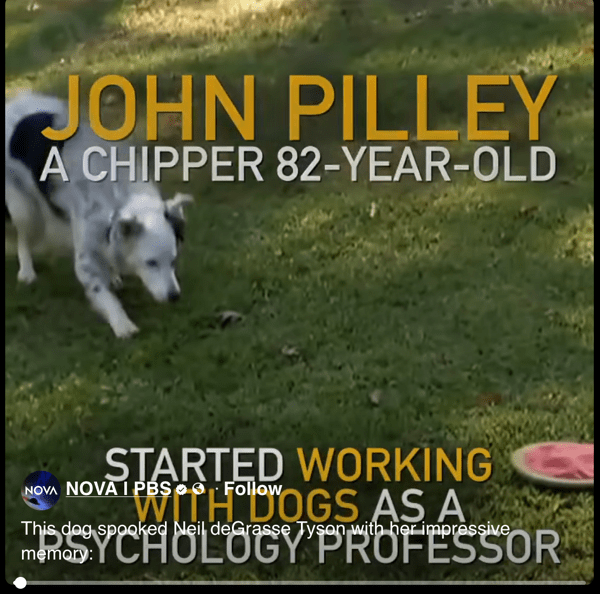
This dog spooked Neil deGrasse Tyson with her impressive memory:

# – # – # – # – #

How little we understand and if a dog can do this, why can’t I? 

— 30 —


INSPIRATIONAL: Personal Encyclopedias — whoami.wiki — a personal encyclopedia

Monday, May 18, 2026

https://whoami.wiki/blog/personal-encyclopedias

*** begin quote ***

This is when I realized I was no longer working on a family history project. What I had been building, page by page, was a personal encyclopedia. A structured, browsable, interconnected account of my life compiled from the data I already had lying around.

I’ve been working on this as whoami.wiki. It uses MediaWiki as its foundation, which turns out to be a great fit because language models already understand Wikipedia conventions deeply from their training data. You bring your data exports, and agents draft the pages for you to review.

*** end quote ***

Wow I really think this fellow is on to something potentially very big.

Think about it “a personal encyclopedia”!

It could be a fascinating project for a child, a family, or a group.

It might be the “holy grail” of “Personal Knowledge Management”.

When I get settled in Flori-duh, I’ll explore it further. Probably dedicate a computer to it. If I can figure out how to do it, make it online for everyone to join.’

“But there is no foole to the olde foole, folke saie.” — John Heywood’s 1546 glossary

Laugh!

— 30 —


INSPIRATIONAL: Dr. Frances Oldham Kelsey just said…”no”

Sunday, March 8, 2026

She just said…”no”


Dr. Frances Oldham Kelsey was born on Vancouver Island in 1914, in a small fishing village called Cobble Hill. Her childhood was not one of privilege, but it is said that she threw herself into reading, with a curiosity that could not be contained.

Kelsey won admission to McGill University, where she studied pharmacology. She graduated with honors and was quickly recognized by leading researchers for her meticulous attention to detail.

In the 1930s, discrimination was so baked into academia that when McGill professor E.M.K. Geiling requested a new graduate assistant, the university, assuming “Frances” was a man, sent her name. He was surprised when she arrived, but her work ethic won him over. With Geiling she helped investigate a series of tragic deaths linked to a toxic solvent in a sulfanilamide drug formulation, an early experience that shaped her lifelong insistence on drug safety.

She earned her Ph.D. in 1938 at the University of Chicago, and then a a degree in medicine in 1950, making her a dual-trained physician-pharmacologist.

The Call From Washington

In 1960, at age 45, Kelsey applied for a medical officer position at the U.S. Food and Drug Administration. The FDA also assumed that “Frances” was a man. But they quickly learned that she was, as one coworker later said, “the toughest reviewer in the place.”

Her very first major assignment seemed routine. She was to review a new sedative widely marketed in Europe for anti-nausea in pregnancy. The drug was called thalidomide, and the review was considered a formality for approval in the United States.

The Woman Who Said No

Kelsey refused to sign off.

She noticed details that others ignored:

  • The company had not provided rigorous U.S. clinical trial data.

  • Peripheral neuropathy was showing up in European patients.

  • Animal studies were incomplete.

  • Most importantly, no one had tested it for effects on pregnancy, despite its heavy use by pregnant women.

By regulation, she could defer approval for thirty days. So as each month rolled around, she put in another deferral. For a new employee, this was a radical thing to do.

For months, the drug company pressured her: phone calls, letters, meetings, repeated complaints to her supervisors. But Kelsey held firm. She had seen what rushed approvals could do. Something about thalidomide felt wrong.

Then, in late 1961, what she feared became a reality: reports poured in from Europe and Australia of babies born with catastrophic limb deformities, a condition called phocomelia, after their mothers took thalidomide early in pregnancy.

National Recognition Came Swiftly

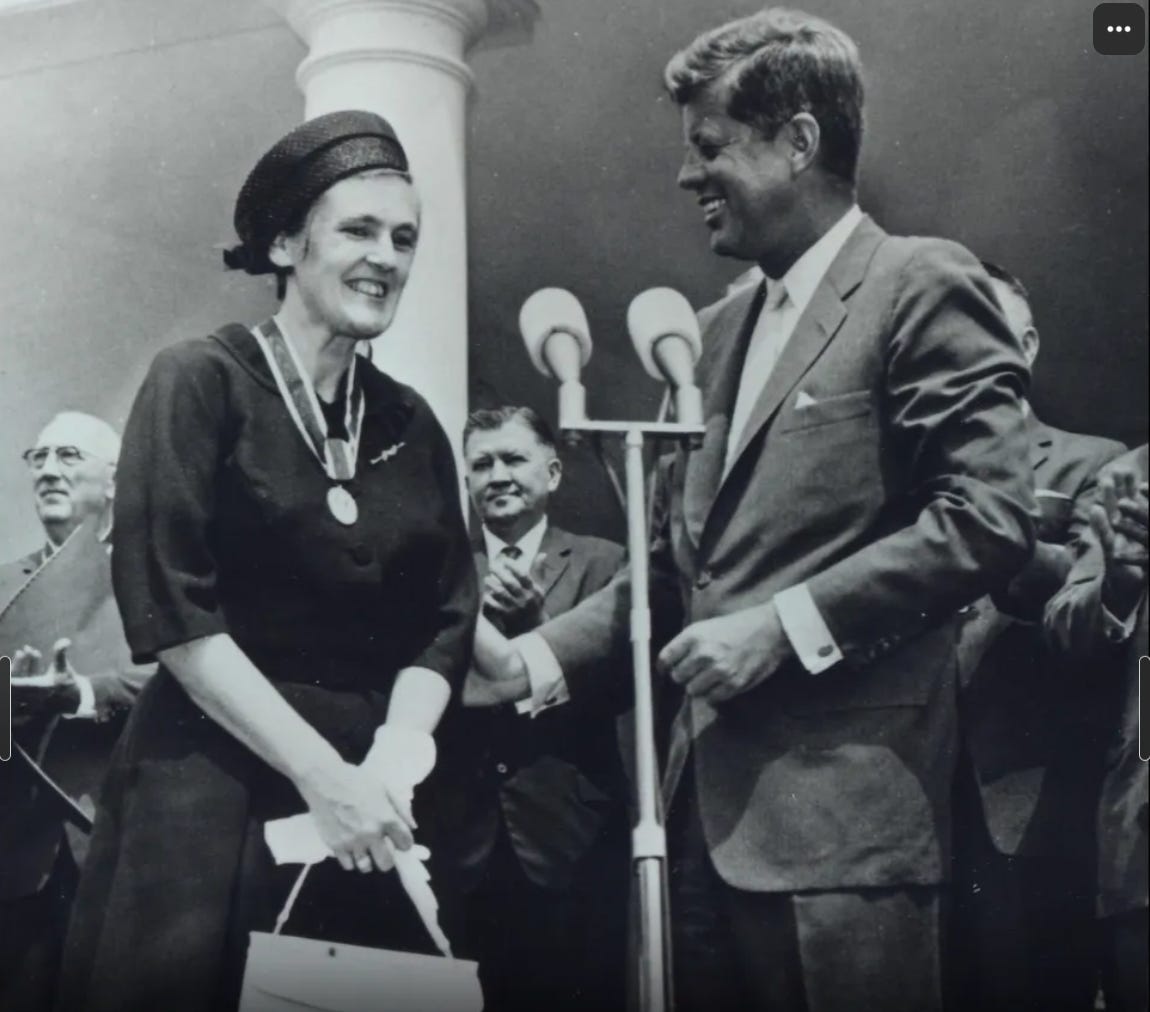
In 1962 President John F. Kennedy awarded her the President’s Award for Distinguished Federal Civilian Service, one of the highest honors a civilian can receive. Kennedy praised her refusal to bow to commercial pressure and noted that her actions had saved countless families from heartbreak.

Her work also triggered the passage of the 1962 Kefauver-Harris Amendments, which transformed the FDA and made modern drug regulation possible: requiring proof of safety and efficacy, informed consent in clinical trials, and strict oversight of advertising claims.

Unfortunately, this act was diluted by the 1997 FDA Modernization Act (FDAMA) which paved the way for modern advertising, by allowing more direct-to-consumer (DTC) broadcast ads.

A Lifelong Career in Drug Safety

Kelsey continued her work at the FDA for many decades. She led the new drug evaluation office, mentored younger scientists, and remained a fierce advocate for evidence-based medicine.

Even in her 80s, she was still teaching and reviewing cases. At age 90, she retired.

Frances Kelsey lived to be 101. She died in 2015, just two weeks after the Canadian government formally recognized her as a national hero. It only took the Canadian government 55 years to recognize her accomplishments. During her long career, she never received the Nobel Prize in Medicine, as that is reserved for discovering something new, rather than preventing harm.

She never sought fame. She never cashed in her story. She remained, throughout her life, a scientist committed to one principle: patients deserve protection, not assumptions. That informed consent is paramount for patient’s right.

— 30 —


INSPIRATIONAL: Women’s History Month 2026?

Sunday, March 1, 2026

When Is Women’s History Month 2026?

Women’s History Month has been celebrated every March since it was officially recognized by U.S. Congress in 1987. This date coincides with International Women’s Day, which falls on Saturday, March 8, 2026.

Women’s History Month 2026 will begin on Sunday, March 1st, and conclude on Tuesday, March 31st.

What Are 5 Facts About Women’s History Month?

  1. It started as a single day: Women’s History Month originated as a single Women’s History Day in 1978 in Sonoma County, California, before expanding into a week and eventually a month.
  2. The first official Women’s History Month was in 1987: After years of advocacy, Congress declared March as Women’s History Month in 1987.
  3. Women’s History Month has inspired similar initiatives worldwide: While it began in the United States, countries like Canada and the UK now celebrate their own versions, highlighting the global importance of recognizing women’s contributions.
  4. The month highlights women from all walks of life: Women’s History Month doesn’t only honor well-known female figures – it also celebrates everyday women who have made meaningful contributions to their communities and industries.
  5. Presidents issue annual proclamations: Since 1988, every U.S. president has issued a proclamation recognizing Women’s History Month and its significance.

— 30 —