TECHNOLOGY: Tried to put Google Voice on to my the free, and unequaled, wordpressdotcom blog — NG!

Thursday, March 12, 2009

Tried to put the new Google Voice on my blog

<embed src=”http://embed.grandcentral.com/webcall/87646957276d5456517b27b724819231&#8243; width=”227″ height=”93″ wmode=”transparent”></embed>

<A HREF=”http://www.backwoodshome.com”><IMG SRC=”http://www.backwoodshome.com/banners/bhms1.gif&#8221; WIDTH=”120″ HEIGHT=”120″ BORDER=”0″ ALT=”Backwoods Home Magazine – practical ideas for self-reliant living”></A>

<A HREF=”http://embed.grandcentral.com/webcall/87646957276d5456517b27b724819231″><IMG SRC=”http://embed.grandcentral.com/webcall/87646957276d5456517b27b724819231&#8243; width=”227″ height=”93″</A>

<img style=”visibility:hidden;width:0px;height:0px;” border=0 width=0 height=0 src=”http://counters.gigya.com/wildfire/IMP/CXNID=2000002.11NXC/bT*xJmx*PTEyMzY4NzEyMjExNDQmcHQ9MTIzNjg3MTI*NjgxMiZwPUdyYW5kQ2VudHJhbCZkPSZnPTEmdD*mbz*5NmUxOWFhYzUyYjQ*OGI5YTQwMmFhMTgxYTQ1NmJkNA==.gif&#8221; /><embed src=”http://embed.grandcentral.com/webcall/87646957276d5456517b27b724819231&#8243; width=”142″ height=”54″ wmode=”transparent”></embed>

<A HREF=”http://embed.grandcentral.com/webcall/87646957276d5456517b27b724819231″><IMG SRC=”http://counters.gigya.com/wildfire/IMP/CXNID=2000002.11NXC/bT*xJmx*PTEyMzY4NzEyMjExNDQmcHQ9MTIzNjg3MTI*NjgxMiZwPUdyYW5kQ2VudHJhbCZkPSZnPTEmdD*mbz*5NmUxOWFhYzUyYjQ*OGI5YTQwMmFhMTgxYTQ1NmJkNA==.gif&#8221; width=”150″ height=”93″</A>

Failed!

# # # # #


TECHNOLOGY: “National Cyber Leap Year” is not at all what it sounds like!

Thursday, March 5, 2009

http://edocket.access.gpo.gov/2009/E9-4321.htm” title=”http://edocket.access.gpo.gov/2009/E9-4321.htm”>http://edocket.access.gpo.gov/2009/E9-4321.htm”>http://edocket.access.gpo.gov/2009/E9-4321.htm”>http://edocket.access.gpo.gov/2009/E9-4321.htm

Request for Input (RFI) – National Cyber Leap Year 9110–9112 [E9–4321]</p>

*** begin quote ***

Overview: This Request for Input No. 3 (RFI-3) is the third issued under the Comprehensive National Cybersecurity Initiative (CNCI), established within Homeland Security Presidential Directive (HSPD)-23. RFI-3 was developed by the Networking and Information Technology Research and Development (NITRD) Program Senior Steering Group (SSG) for Cybersecurity to invite participation in a National Cyber Leap Year whose goal is an integrated national approach to make cyberspace safe for the American way of life. Over 160 responses were submitted to the first RFI issued by the NITRD SSG (October 14, 2008), indicating a strong desire by the technical community to participate. on December 30, 2008) expanded the opportunity for participation by permitting submitters to designate parts of submissions as proprietary. RFI-3 presents prospective cyber security categories derived from responses to RFI-1 for further consideration.

Background: We are a cyber nation. The U.S. information infrastructure–including telecommunications and computer networks and systems and the data that reside on them–is critical to virtually every aspect of modern life. This information infrastructure is increasingly vulnerable to exploitation, disruption, and destruction by a growing array leap-ahead research and technology to reduce vulnerabilities to asymmetric attack in cyberspace. Unlike many research agenda that aim for steady progress in the advancement of science, the leap-ahead effort seeks just a few revolutionary ideas with the potential to reshape the landscape. These game-changing technologies (or non-technical mechanisms that are made possible through technology), developed and deployed over the next decade, will fundamentally change the cyber game into one where the good guys have an advantage. Leap-ahead technologies are so-called because they enable us to leap over the obstacles preventing us from being where we want to be. These advances may require years of concerted research and development to be fully realized; good ideas often do. However, the intent is to start now and gain momentum as intermediate results emerge.

Objective: The National Cyber Leap Year has two main goals: (1) Constructing a national research and technology agenda that both identifies the most promising ideas and describes the strategy that brings those ideas to fruition; and (2) jumpstarting game-changing, multi-disciplinary development efforts. The Leap Year will run during fiscal year 2009, and will comprise two stages: Prospecting and focusing.

*** end quote ***

And, how much did this cost me?

# # # # #


HARDWARE: $100 Linux wall-wart launches

Tuesday, March 3, 2009

http://linuxdevices.com/news/NS9634061300.html

$100 Linux wall-wart launches

Feb. 24, 2009

*** begin quote ***

Marvell Semiconductor is shipping a hardware/software development kit suitable for always-on home automation devices and service gateways. Resembling a “wall-wart” power adapter, the SheevaPlug draws 5 Watts, comes with Linux, and boasts completely open hardware and software designs, Marvell says.

In typical use, the SheevaPlug draws about as much power as a night-light. Yet, with 512MB each of RAM and Flash, and a 1.2GHz CPU, the unobtrusive device approaches the computing power found in the servers of only a decade ago.

Furthermore, the platform is available in single quantities, and is priced within reach of students, hobbyists, and tinkerers. Its hardware design is completely open — everything from schematics to Gerber files will be available on a website, Marvell said. For those that do wish to build products on the platform, volume pricing could fall to $50, Marvell expects.

On the software side, the company says ARM ports of several popular Linux distributions are already running, and included. More importantly, Marvell has committed to do everything it can to ensure the best Linux support for SheevaPlug going forward. Raja Mukhopadhyay, product marketing manager, commented, “Whatever the community needs to facilitate development, we will provide the critical resources needed to facilitate that.”

Mukhopadhyay calls the SheevaPlug an “ideal platform for in-home service delivery,” and adds that he is looking forward to seeing what kinds of products and services are built on top of the device. He said, “We believe that for the consumer and the service provider in the home, it’s the right time for some disruptive application delivery. We believe that having a completely open hardware platform will be key in letting people productize it however they want.”

*** end quote ***

If it supports “power line networking” or wifi, then you have a server on your wall.

Fantastic!

# # # # #


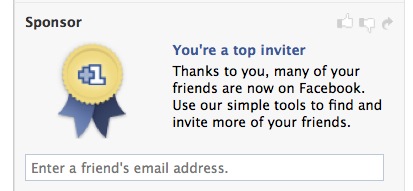
SERVICE: FACEBOOK says “You’re a top inviter”

Monday, March 2, 2009

200903021925.jpg

# # # # #


SERVICE: One example of why you SHOULD NOT use your ISP’s email address

Monday, March 2, 2009

http://www.dslreports.com/forum/remark,21951743

*** begin quote ***

[E-mail] Someone else closed my email accounts

from Comcast HSI forum – dslreports.com community

I opened an account with Comcast for the first time in 2004. I signed up for HSI and Cable TV. I was asked to use a comcast email address for the account. I chose my email address and password and was given the green light. I have successfully used that account for 4 1/2 years. My wife had an email address, I used a second address for my new business and my daughter used an address. In Nov 2007 I had problems with my cable and contacted support. They asked if had lived in Texas and transfereed the account to Colorado. I have never lived in Texas. They found out that my account had somehow been linked to an account in Texas with a gentleman with the same name. After 19 minutes on the phone they told me the problem had been taken care of. Today I was unable to log into any one of my 4 email accounts. I contacted support and they again asked if I had moved to Colorado from Texas. They stated a gentleman in Texas with the same name closed his Comcast account and my first email address was actually owned by him. Since he was the legal owner of the email address, they said there was nothing they could do. I have used that email address for my account with no problems. Was not getting anyone elses emails and things were not mysteriously missing from mine. I have no issues with any type of identity theft and my credit has no unauthorized activity. Today they said a different address was assigned to my billing account that was very similar but not the one I have been using. For the past 4 years when I logged into my account from the Comcast website, I would use my email address and password and it would show my account information. After the gentleman in Texas cancelled his account, I continued to receive HSI access and cable TV. I have received and paid bills for all services. I am in the middle of a civil lawsuit where several of my saved emails were evidence. Also saved in email folders were privleged information from my clients, attorneys and the courts. My questions are; Does anyone know how this could happen? Do I have any hope of retreiving my saved emails? If they said my first email was owned by someone else then why can’t my wife and daughter get into their accounts? Is there any recourse? Any advice? I requested a supervisor who stated they will researching the issue and get back to me in 24 hours.

*** end quote ***

I’m sure that the other ISPs all have their own horor stories. Without getting into what I know about the Comcast email infrastructure, why put yourself in that position in the first place?

My WSP http://www.1and1.com/?k_id=9113251 — for example, I could really care less if you use them, if you do I think I get fifty cents — offers for 48 $/year to provide you with a domain name, 10 Gig of web space, 300 Gig / month of transfer, 600 email addresses with POP, IMAP, and WEB access, and bunch of other stuff.

So why would you EVER put your email and web site at risk?

You can guess why the ISP “gives” you anything for “free”.

# # # # #


TECHNOLOGY: The Digital TV shift screwed up big time!

Sunday, March 1, 2009

http://blog.wired.com/business/2009/02/how-the-governm.html

How We Bungled the Digital Television Transition By Eliot Van Buskirk EmailFebruary 20, 2009 | 2:39:09 PM

*** begin quote ***

This additional factor added to the need for this expensive delay. “Why the hell – excuse me – why in 2005 did they decide February 17th was a good time for this transition?”

*** end quote ***

It’s just another example of “gooferment”!

Never mind the Fifth Amendment violate against “takings”. Which this was pure and simple.

More money down the DC rathole!

# # # # #


SERVICE: FACEBOOK mistake documented!

Sunday, March 1, 2009

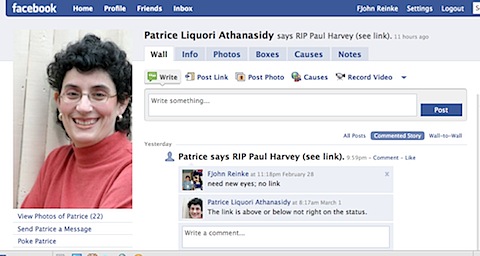
One of my fellow alums posted a status referring to a link.

200903011134.jpg

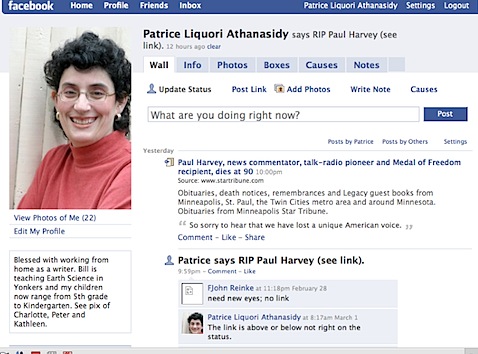
So I queried, an she sent back:

200903011137.jpg

So, clearly, we have nailed a FACEBOOK error!

The same page shows her one thing and me another.

Love it!

Talk to me about “cloud computing” some more.

# # # # #


SERVICE: WIKIPEDIA the sum of flawed human efforts

Saturday, February 28, 2009

http://en.wikipedia.org

There’s no doubt that I like this. I recently spent some time editing pages about my fellow alums. (Hey, you can’t always be seeking that elusive CTO08824!)

It’s a great resource. At best, I’d call it uneven. When you consider it’s the sum of many people each moving a pebble to create the great pyramid, it’s astonishing.

So go move a pebble! I am.

# # # # #


SERVICE: TinyChat is free allows creation of a simple disposable chat room

Friday, February 27, 2009

http://www.techcrunch.com/2009/02/18/tinychat-makes-creating-disposable-chat-rooms-a-breeze/

http://www.tinychat.com

About & FAQ

TinyChat is a free service that allows you to create a free chat room that is accessible by anyone with a browser. Simply create a chatroom from the homepage then send the link it gives to you to anyone you want to chat with. After you leave the chat room, all the chat data is gone, so its perfect for secure chats.

Why would you use this? Its the easiest way to have a group chat with multiple people. No more worrying about who has what messenger, or what everyones screen name is. Just send them a link! Its also a great way to talk with people who are not the most computer literate- Now you dont need them to install any programs to talk with someone!

Privacy Statement

Any chats you take part in are viewable by any other users in the chat room. Dont say anything you wouldnt want to say to a complete stranger. These chat rooms are disposable, meaning that once you leave the chat room you will be unable to re-view the content you saw previously, unless you save the log. To be blunt- Once you leave the chat room, you cant view the data again- Its gone.

# – # – #

Interesting and useful. Here’s a neat little app that the terrorists can use. Chat room. Created ad hoc and disposed of. Hmmm? To bad no one ever wants to chat with me. :-(

# # # # #


TECHNOLOGY: Cloud computing road blocks

Thursday, February 26, 2009

http://www.donationcoder.com/Forums/bb/index.php?topic=17067.msg151351#msg151351

http://www.eecs.berkeley.edu/Pubs/TechRpts/2009/EECS-2009-28.pdf

   * 1. Availability of service

   * 2. Data lock-in

   * 3. Data confidentiality and auditability

   * 4. Data transfer bottlenecks

   * 5. Performance unpredictability

   * 6. Scalable storage

   * 7. Bugs in large distributed systems

   * 8. Scaling quickly

   * 9. Reputation fate sharing

   * 10. Software licensing

# – # – #

An excellent summary. Now how do you navigate around them?

# # # # #