MONEY: Who pays the bill for inflation?

Saturday, December 31, 2011

“The American people have no idea they are paying the bill. They know that someone is stealing their hubcaps, but they think it is the greedy businessman who raises prices or the selfish laborer who demands higher wages or the unworthy farmer who demands too much for his crop or the wealthy foreigner who bids up our prices. They do not realize that these groups also are victimized by a monetary system which is constantly being eroded in value by and through the Federal Reserve System.” – G. Edward Griffin, The Creature from Jekyll Island: A Second Look at the Federal Reserve, p. 33

# – # – #

The root of all our problems is the “money”. It’s faith-based. And, once you lose “faith”, what else do you have?

# – # – # – # – #


MONEY: “counter party risk” in 401k and IRA accounts

Friday, December 30, 2011

http://barnhardt.biz/

The Sick Truth About 401ks Finally Sinks In
Posted by Ann Barnhardt – December 12, AD 2011 4:22 PM MST

*** begin quote ***

Possession is nine-tenths of the law.

*** and ***

So, this nasty business brings us around to a very nasty, but inevitable question. Was that money ever yours, or has the entire 401k fiasco been nothing more than an underhanded, stealth confiscatory tax for the vast majority of folks who have participated in it over the years? I’d have to say, “affirmative” to the latter. If you are denied access to “your money”, then honey, it ain’t “your money” and never was. Many of you have been conned into working for a salary that was x percent less than what you were told, with “x” being the percent “contributed” to “your” 401k account. That “x percent” should be added to your marginal tax rate, because it is probably going to end up in the coffers of the United States Treasury by way of J.P. Morgan, Goldman Sachs, or HSBC, or one of the other big crypto-fascist banks, by way of London, just like the MF Global money.

*** and ***

A.) CEASE ALL NEW CONTRIBUTIONS IMMEDIATELY.

B.) If there is a loan option attached to your 401k program, take out the maximum possible loan and set up the SLOWEST possible repayment schedule.

C.) Never again enter into an arrangement wherein “your money” is unavailable to you and is anything less than completely liquid.

Possession truly is nine-tenths of the law, and under a lawless Marxist-Communist-Fascist government where the rule of law no longer exists (such as we are in now), possession is closer to ten-tenths of the law.

*** end quote ***

When the politicians and bureaucrats look around for “available money”, there are tens of trillions of dollars in 401k and IRA accounts.

Are you scared yet?

That’s your risk!

Greedy politicians.

# – # – # – # – #   


MONEY: Understanding “counterparty risk”

Thursday, December 22, 2011

Jim’s Quote of the Day:

via SurvivalBlog.com by James Wesley, Rawles on 12/14/11

*** begin quote ***

“Anything that is on paper anything that involves a promise or a commitment is no longer valid because as we said there isn’t a rule of law anymore. People can steal from you. Your money can be confiscated. And think how easy now it is to confiscate people’s wealth. Most of our wealth in this society exists as zeroes and ones on a computer server. It takes no effort whatsoever to steal zeros and ones on a computer server. So what I have been telling people is you need to get into physical commodities. And the rule of thumb is if you can stand in front of it with an assault rifle and physically protect it, then it’s real—it’s a real commodity. That includes food, that includes water, that includes long guns and ammunition. That includes fuel. That includes precious metals—gold and silver coinage. Most especially silver coinage because silver is the metal of barter and transaction and currency.” – Ann Barnhardt, former head of Barnhardt Capital Management. (She ran the firm before she went Galt.)

*** end quote ***

When I was on Wall Street, it was called “counterparty risk”. And, everyone was very very worried about it.

So when MF GLOBAL goes broke, all the “counterparties” are <synonym for the past tense of the procreation act>!

That’s why you see all the screaming to Congress and the “regulators” cause they were robbed.

When you have your bullion coins (e.g., platinum, gold, palladium, silver, nickels <yeah the 5¢ coins>, pennies) in you hand or buried in your backyard, there’s no counterparty risk. There are other risks, but not from Corzine and his ilk.

When you have something that’s paper, you’ve got “counterparty risk”. Even if that paper is a faith-based curency like a “dollar” (whatever that is) aka Firbie (i.e., federal reserve banknote).

Toilet paper is more intrinsically valuable.

# – # – # – # – #   


MONEY: Commodity and Faith-based money

Monday, December 12, 2011

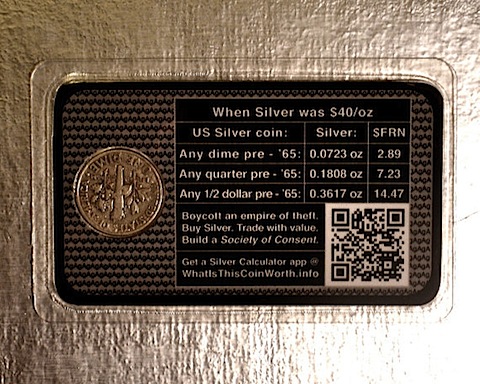
http://www.etsy.com/listing/87887353/silver-dime-trading-cards-police-state

201112050126.jpg

Understanding “value”. What is “wealth”? What is a “dollar”?

“We, The Sheeple” have been fooled into thinking that a “dollar” can be used to measure “wealth”.

“Money is a matter of functions four, a medium, a measure, a standard, a store.” He repeated that four times like poetry. “Six Characters in Money: Portable – Durable – Divisible – Uniformity – Limited Supply – Acceptability.” — CHURCH 10●19●62 (Vol 1) 978-0-557-08387-9 page 110

While a “dollar” is STILL a medium of exchange — at least until OPEC demands to be paid for its oil in gold — that what tripped up old Saddam and “Colonel” Gaddafi — it fails a measure or standard. And, it acts very badly as a store of value or wealth.

Imagine a bunch of “dollars” in a storehouse or a pirate’s chest. The Gooferment, more specifically the Federal Reserve System. also mistakenly called the Federal Reserve Bank, can, by silently quietly sneakily PRINTING more “dollars”, can erode the value, aka purchasing power, of all the “dollars” in circulation. In fact, it’s even gotten easier nowdays. All they do now is go into their computer system and add some zeros. And, poof, they’ve “virtually” printed more dollars. It’s just that easy. Like a Ponzi scheme without all the fuss and muss.

Need an better metaphor, go get a monopoly game. There are a fixed number of houses in a real game. Make yourself “the banker”. Then. give yourself a bunch of house and hotels from a different game set. Place them on your properties as soon as you can slip them in. Call it “Quantitative Easing” or “Buying Bonds by the Open Market Committee”. If the other players say you’re cheating, send in your army and compel them to shut up and play. Kinda hard not to “win”.

Eventually, the marketplace discovers the fraud. All those “new” “dollars” eventually cause prices to rise as more “dollars” chase the same amount of goods.

If you were interested, we could probably come up with a funny example on “Robinson Crusoe’s island”. On Robinson’s island, besides Robinson and Friday, we need to add a banker like the FED and a few people. Let’s say, Robinson catches fish and Friday collects coconuts. At first the island population exchanges things, fish for coconuts. In fact, eventually something becomes the medium of exchange. The “firewood guy, as well as the butcher, the baker. and the candlestick maker, all have to exchange for coconuts. The candlestick maker, if he wants bread but the baker doesn’t want a candlestick, has to go to Friday and exchage a candlestick for some coconuts that the baker does want. Cumbersome. The banker has printed paper receipts that he give out when folks deposit their coconuts with him for safekeeping. A paper receipt for ten coconuts is easier to carry. All well and good. The marketplace establishes prices as eventually Robinson’s fishes are bid for by the villages. Eventually in every bidding war, some one says “thanks, but no thanks”. One fish equals two coconuts; one candlestick is 10 coconuts. And so on and so on. Now our banker prints up more paper receipts. The result is that there are more receipts chasing the same amount of goods, prices rise. And, until everyone wants their coconuts from the banker, the scam works. In the USA, when the scam is discovered, and folks lie up to get their gold for their greenback, FDR says “You can own gold and only foreign governments can exchange dollars for gold”. Up until, DeGaule or France says “I don’t want paper dollars” and Nixon says “Gold window is closed”. And, “We, The Sheeple” and the rest of the world just go along with the joke.

It’s like playing Monopoly where the player / Banker has an extra stash of Monopoly money in their hands that they “printed up”. Hard to “win”.

Argh!

That’s why “hard money” (i.e., money based on a commodity that can’t be printed like gold) is so much better for real people that “faith based money” (i.e., it’s money because someone says it is)!

# # # # #


MONEY: Fat cats surely want to keep the FED secrets; vote Ron Paul

Tuesday, November 29, 2011

http://www.bloomberg.com/news/2011-11-28/secret-fed-loans-undisclosed-to-congress-gave-banks-13-billion-in-income.html

Secret Fed Loans Helped Banks Net $13 Billion
By Bob Ivry, Bradley Keoun and Phil Kuntz – Nov 27, 2011 7:01 PM ET
Bloomberg Markets Magazine

*** begin quote ***

Nov. 28 (Bloomberg) — Bloomberg Markets magazine’s January issue examines how the Federal Reserve and big banks fought for more than two years to keep details of the largest bailout in U.S. history a secret. And how bankers failed to mention that they took tens of billions of dollars in emergency loans at the same time they were assuring investors their firms were healthy. (Source: Bloomberg)

The Federal Reserve and the big banks fought for more than two years to keep details of the largest bailout in U.S. history a secret. Now, the rest of the world can see what it was missing.

The Fed didn’t tell anyone which banks were in trouble so deep they required a combined $1.2 trillion on Dec. 5, 2008, their single neediest day. Bankers didn’t mention that they took tens of billions of dollars in emergency loans at the same time they were assuring investors their firms were healthy. And no one calculated until now that banks reaped an estimated $13 billion of income by taking advantage of the Fed’s below-market rates, Bloomberg Markets magazine reports in its January issue.

Saved by the bailout, bankers lobbied against government regulations, a job made easier by the Fed, which never disclosed the details of the rescue to lawmakers even as Congress doled out more money and debated new rules aimed at preventing the next collapse.

*** end quote ***

Argh!

Clearly, “We, The Sheeple” have no idea how badly they are being screwed!

Ron Paul’s demand to audit the Fed is the first step to cleaning the stable.

Naturally the crony capitalists don’t want their perfidy to be exposed.

“Central Banking” has long be criticized as a banking cartel that’s run, like OPEC is for the oil producers, for the benefit of the bankers.

It’ll take some smart thinking to unwind this disaster. We have to begin with the audit. Everyone needs to know how deep a hole we are in. Like the debt, deficit, and out-of-control spending, the journey of trillions of dollars starts with the first step.

After all, what is a “dollar”?

# # # # #


MONEY: BITCOINS … a new liberty

Sunday, November 27, 2011

http://www.weusecoins.com/

# # # # #

A revolution in money!

http://www.youtube.com/watch?v=Um63OQz3bjo&feature=player_embedded

# # # # #


MONEY: Chile’s Private Pension System

Thursday, November 24, 2011

http://www.cato.org/pubs/ssps/ssp-17es.html

Chile’s Private Pension System at 18: Its Current State and Future Challenges
by L. Jacobo Rodríguez
L. Jacobo Rodríguez is assistant director of the Project on Global Economic Liberty at the Cato Institute.

*** begin quote ***

Executive Summary

In May 1981 Chile replaced its government-run pay-as-you-go retirement system with an investment-based private system of individual retirement accounts. The new system has allowed Chile and other Latin American countries that have followed the Chilean example to defuse the fiscal time bomb that is ticking for countries with pay-as-you-go systems, as fewer and fewer workers have to pay for the retirement benefits of more and more retirees. More important, Chile has created a retirement system that, by giving workers clearly defined property rights in their pension contributions, offers proper work and investment incentives; acts as an engine of, not an impediment to, economic growth; and enhances personal freedom and dignity.

In the 18 years since the Chilean system was implemented, labor force participation, pension fund assets, and benefits have all grown. Today, more than 95 percent of Chilean workers have their own pension savings accounts; assets have grown to over $34 billion, or about 42 percent of gross domestic product; and the average real rate of return has been approximately 11.3 percent per year, which has allowed workers to retire with better and more secure pensions.

Its success notwithstanding, the Chilean system has found many critics, who often point to high administrative costs, lack of portfolio choice, and the large number of transfers from one fund to another as evidence that the system is inherently flawed and inappropriate for other countries, including the United States. Some of those criticisms are misinformed. Many other criticisms reflect real problems, but they are largely the result of excessive government regulation.

The spirit of the reform has been to relax regulations as the system has matured and as the fund managers have gained experience. All the ingredients of success — individual choice, clearly defined property rights in contributions, and private administration of accounts — have been present since 1981. If Chilean authorities address the remaining shortcomings with boldness, we should expect Chile’s private pension system to be even more successful in its adulthood than it has been during its first 18 years.

*** end quote ***

“That retirement programs financed on a pay- as-you-go basis are … in essence are intergenerational transfers of wealth …”

“retirement programs financed on a pay- as-you-go basis are on the verge of collapse … have made old-age financial security dependent on the political process.”

“a fully funded, defined-contribution scheme, mandatory … administered by specialized, single-purpose private companies …, which are pension fund administrators”

It allowed workers to choose to stay with the old system or join the new one.

“government recognition bonds that acknowledged the contributions they had already made to the old system”

10% mandatory, 10% optional tax-deductable, and additional voluntarily.

Free choice of the rival plans and a cost free switch twice a year and a six month lock in.

Government acts as a regulator and guarantor of last resort.

True net costs of moving from old to new are effectively zero.

Problems:

* Minimum return guarantee rule and the strict return comparisons stifle competition between the offerings.

* Administrative expenses are “high” but only 42% of the “old” system.

* Frequent change by participants drive up cos


MONEY: What is money?

Wednesday, November 23, 2011

http://rpflix.com/2818

“double coincidence of wants”

“indirect exchange”

commodity becomes medium of exchange

the indivisible cow

# – # – # – # – #   


MONEY: Currency controls portends worse things to come

Tuesday, November 22, 2011

http://www.washingtontimes.com/news/2011/nov/12/currency-control-efforts-worry-argentines/?page=2

Currency control efforts worry Argentines
By Kelly Hearn – Special to The Washington Times
Saturday, November 12, 2011

*** begin quote ***

In 2008, Mrs. Fernandez surprised markets when she nationalized the country’s private pension funds. She also stripped the central bank of its independence by firing a former bank director for refusing to make foreign reserves available to service the nation’s debt.

*** end quote ***

When the USA’s Federal Gooferment needs trillion and they cast their eyes around for big pots of money, “IRAs and 401Ks” looks like the pot of gold at the end of the rainbow.

Remember all those trial balloons? “IRAs and 401Ks are tax expenditures”! And, “In exchange for an enhanced social security benefit”. Plus, my personal favorite, “is to the savers’ benefit to eliminate market risk.”

(No mention of “sovereign risk”!)

Sigh, how stupid can “We, The Sheeple”be?

“Capital Controls” and all the “foreign account” “barbara streisand” is all about the “drug addicts” in DC jonesen for a fix of cash!

It CAN happen here! Because it has. Look at the FDR gold confiscation.

# # # # #


MONEY: The difference between capital and money

Saturday, November 19, 2011

http://dailyreckoning.com/the-illusion-of-capital/

The Illusion of Capital
By Dan Amoss

*** begin quote ***

11/11/11 Jacobus, Pennsylvania – The world’s “faith-based” monetary system is breaking down before our eyes. Don’t be caught off guard.

*** and ***

A few weeks ago, as I was rolling up the tracks from Baltimore to New York, my gaze landed on an oil refinery. A little while later, I spotted a casino. Then I started to think about these two very different forms of capitalism — one that relies on an intensive investment of physical capital and one that relies almost entirely on paper money.

Is one of these forms of capitalism inherently better than the other? Does one of them produce a more enduring prosperity?

Yes, to both questions.

Passing by Sunoco’s Marcus Hook Refinery, you can’t help but admire this feat of engineering. Situated on the Delaware/Pennsylvania border, this 800-acre campus covered in miles of steel pipe has the capacity to crack 175,000 barrels of crude oil into refined products in a single day.

Harrah’s Chester Casino & Racetrack does not produce gasoline. It does not produce anything…except a transfer of wealth. It stands in stark contrast to the refinery. The only similarity between the two is that you wouldn’t want either in your backyard.

*** and ***

Contrary to popular opinion, paper money is not wealth. Paper money is a claim on wealth. It only has value to the extent that it can be exchanged for things — a bushel of corn, a gallon of gasoline, a dental cleaning, or an Intel microprocessor.

*** and ***

Investors who hold gold will be very reluctant to sell it when dollar-holders around the world anticipate the endgame of paper monetary systems. For its holders, gold will serve as a solid bridge on the journey from this monetary system to the next.

*** end quote ***

For some reason, this seemed to clearly present the difference between wealth, capital, and money.

I’ve driven by that refinery and played in that casino. That’s a striking difference.

One produces wealth; the other merely some entertainment.

We’ve been deluded into thinking that a bunch of “dollars” are wealth. That refinery and the gas it produces is “wealth”.

I like the expression “faith-based monetary system”! It really sums up what this game of musical chairs is all about.

We’ve had some real world examples of what happens when the music stops — hyperinflation — the pre-WW2 Weimar Germany (that I heard first hand from survivors), circa ‘82 Argentina, or ‘98 Zimbabwe.

The tin foil hats prepare for many types of disasters. Hyperinflation is one of them. First thing to recognize that you have to think in terms of “wealth”; not a “faith based” money. “Beans, bullets, and bandaids” is on the first list; “junk silver” on the second.

Some day, maybe I’ll write the “fat old white guy injineer’s intro to ekkynomics” with stories from a mythical “Robinson Crusoe’s” island. When it’s really simplified. Distilled down to a few facts in a fairy tale, it’s easier to see.

That refinery! The Gooferment can’t print more of them. If a “dollar”, whatever that is, (don’t tell me what it was), is a claim on wealth, then it has to have a value. When the Gooferment, through it’s chief counterfeiter the FED, aka “Federal Reserve Bank” or the “Federal Reserve System”, prints extra “claims”, it’s stealing. Pure and simple.

If “We, The Sheeple” had half credit hour of economics or history, then they’d understand the Ponzi-like scam thatR